
Burt's Investigation of the Town
Children of the CornThis thread follows Burt Robeson's shift from practical reporting to a desperate reconstruction of Gatlin's history and religious order.
increasing Bearing strength in each event
 decreasing
Bearing strength in each eventdecreasingReporting the Death
Reporting the Death
A Practical Obligation
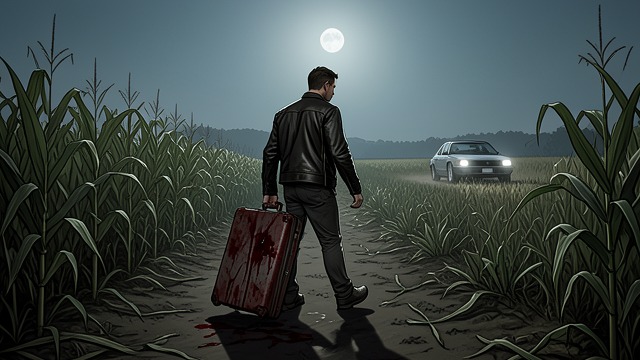
Burt decides to carry the dead boy into Gatlin and report the killing, despite Vicky's wish to turn around and drive to a larger town. He argues that the child belongs to someone's family and that the murder should not be left unreported.
His decision is principled, but it also reflects his reliance on institutions and procedure. Even after seeing the bloodied suitcase and feeling watched from the corn, he assumes that a local authority can take charge of the situation.
A Town That Resists Explanation
Burt continues into Gatlin because leaving the body undiscovered feels morally worse than confronting the town's oddness. The lack of cars and people begins to challenge his expectation that a courthouse or constable will provide an orderly answer.
His investigation starts as a civic errand, not an attempt to expose a supernatural threat. That modest purpose makes the later discoveries more consequential: Burt enters a mystery he does not yet know how to name.
Clues in the Lunchroom
Clues in the Lunchroom
A Place Left Behind
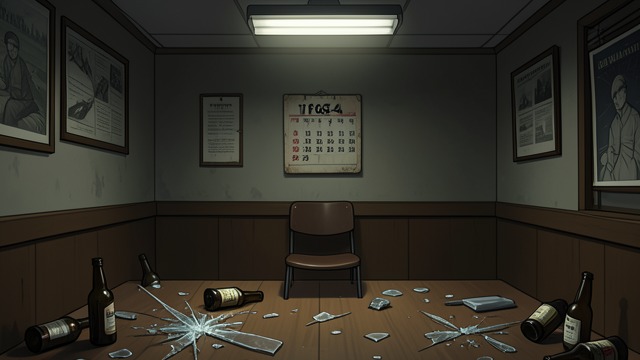
Burt searches the open lunchroom and finds an empty interior, a shattered mirror, and beer taps broken from the counter. The room looks less like a business that has quietly closed than a place whose ordinary social life was forcibly disrupted.
Old menu prices and the calendar dated August 1964 add a time marker to the scene. Burt cannot yet account for it, but the dated objects suggest that Gatlin's present emptiness began with a specific historical break.
Competing Interpretations
Vicky recognizes that the objects make the town feel dangerously out of time and presses Burt to admit that something is wrong. Burt remains committed to finding an authority, even as the evidence weakens his confidence in normal explanations.
The lunchroom becomes an early stage in Burt's investigation because it gives him visible facts rather than rumor. Its abandoned details do not solve the case, but they make the absent adults a question he can no longer ignore.
Reading the Church
Reading the Church
Material Signs of Change
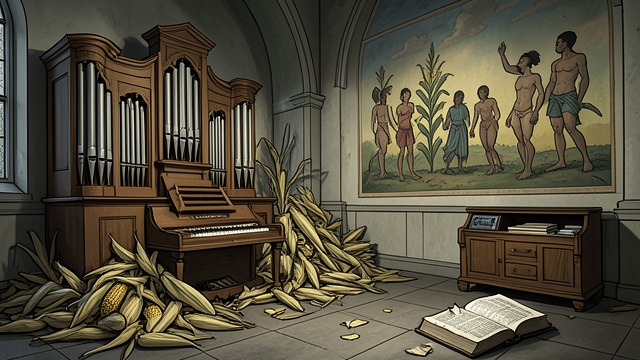
Burt inspects the church and finds its old letters discarded, its organ dismantled, and corn husks used where music once sounded. A mural and a message on the wall recast the sanctuary around corn and human sacrifice.
These objects supply a pattern: the change is organized, not the product of random neglect. Burt begins to understand that whoever controls Gatlin has rewritten its public religion as thoroughly as its town life.
A Disturbing Scripture
The Bible has been altered, with portions removed while much of the Old Testament remains intact. Another book bears a violent doctrine about cutting down the iniquitous to make the ground fertile.
Burt reads the objects as evidence of a community that has made violence sacred. His investigation is still built on inference, but the church has narrowed the possibilities: the town's disappearance of adults is connected to a religious revolution centered on the fields.
Reconstructing 1964
Reconstructing 1964
Names and Dates
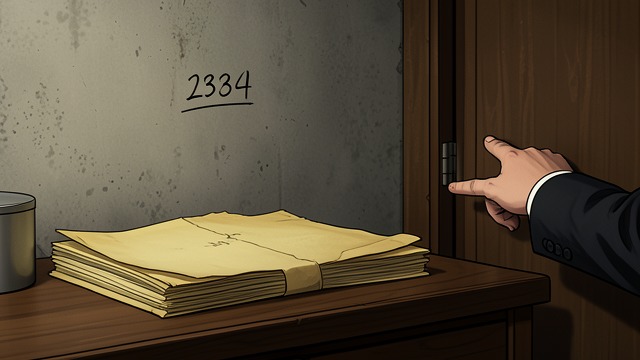
Burt examines the handwritten birth registers and finds entries that point to a break beginning in 1964. The records include children born after the earlier pattern ends, leading him to infer that the community's adult generation may have been killed and that new births followed.
He connects the dates to a possible age rule: the older children appear to face a deadline around nineteen. His theory turns the church records into a rough chronology of the takeover and its subsequent sacrificial order.
A Theory under Pressure
Burt imagines a revolt led by older youths who murdered their parents in the name of the corn. The records cannot prove every part of his reconstruction, but they make the old calendar date and the church's new doctrine fit together.
As he recognizes how such a system might perpetuate itself, the car horn sounds outside. The investigation has brought him close to an explanation, but its practical value disappears at the moment the hidden community begins its attack.
Knowledge without Escape
Knowledge without Escape
The Cost of Discovery
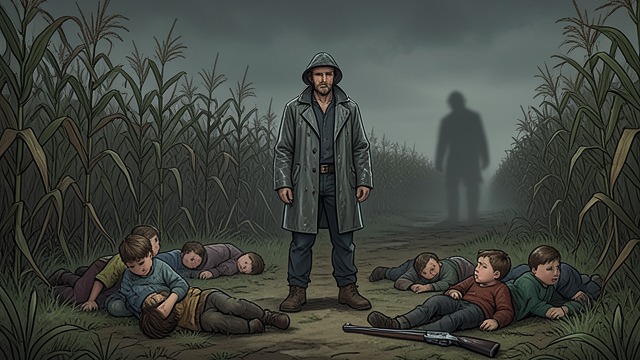
The children attack just as Burt's theory becomes coherent. He cannot reach Vicky or secure the shotgun, and the local institutions he had expected to help are powerless or absent.
His explanation of Gatlin's past therefore gives him no control over its present. Knowledge clarifies why the children act as they do, but it cannot stop them from killing the visitors or protect him from the corn itself.
The Final Confirmation
In the clearing, Burt finds the bodies of earlier victims and then faces the being he had inferred from the church's teachings. The appearance of He Who Walks Behind the Rows confirms that the town's belief is tied to a force beyond ordinary human authority.
Isaac's account the following day places Burt's death within the same history of sacrifice Burt had tried to reconstruct. His investigation ends with a grim confirmation: the system is real, self-renewing, and capable of adapting its rules after each crisis.
After the collision, before reaching Gatlin's town square
Around noon, during Burt and Vicky's stop in Gatlin
Early afternoon, during Burt's examination of the church
At the pulpit, shortly before the car horn sounds
From the attack through the final clearing scene
